what, if anything, did policymakers do in response to the recession of 2001?
Chapter 24. The Aggregate Demand/Aggregate Supply Model
24.4 Shifts in Aggregate Demand
Learning Objectives
Past the end of this section, you volition exist able to:
- Explain how imports influence aggregate demand
- Identify ways in which business conviction and consumer confidence can bear upon aggregate demand
- Explicate how government policy tin can change aggregate need
- Evaluate why economists disagree on the topic of tax cuts
As mentioned previously, the components of aggregate demand are consumption spending (C), investment spending (I), government spending (G), and spending on exports (X) minus imports (1000). (Read the following Clear Information technology Upwardly feature for explanation of why imports are subtracted from exports and what this means for aggregate demand.) A shift of the AD curve to the right ways that at least one of these components increased so that a greater amount of total spending would occur at every cost level. A shift of the AD bend to the left means that at least i of these components decreased so that a bottom amount of full spending would occur at every toll level. The Keynesian Perspective will discuss the components of aggregate need and the factors that impact them. Hither, the discussion will sketch two broad categories that could cause Advertizing curves to shift: changes in the behavior of consumers or firms and changes in regime tax or spending policy.
Practise imports diminish aggregate demand?
We have seen that the formula for aggregate demand is AD = C + I + M + 10 – M, where M is the total value of imported appurtenances. Why is at that place a minus sign in front of imports? Does this mean that more imports will event in a lower level of amass demand?
When an American buys a strange product, for case, it gets counted along with all the other consumption. And then the income generated does not go to American producers, merely rather to producers in another country; information technology would be incorrect to count this every bit function of domestic need. Therefore, imports added in consumption are subtracted dorsum out in the M term of the equation.
Because of the way in which the need equation is written, it is easy to brand the mistake of thinking that imports are bad for the economy. Just go along in mind that every negative number in the M term has a corresponding positive number in the C or I or G term, and they always cancel out.
How Changes by Consumers and Firms Tin can Affect Ad
When consumers feel more confident about the future of the economic system, they tend to consume more. If business organisation confidence is high, then firms tend to spend more on investment, assertive that the future payoff from that investment volition be substantial. Conversely, if consumer or business confidence drops, and so consumption and investment spending turn down.
The University of Michigan publishes a survey of consumer conviction and constructs an index of consumer confidence each month. The survey results are then reported at http://www.sca.isr.umich.edu, which break downwardly the change in consumer conviction amid different income levels. Co-ordinate to that index, consumer conviction averaged around 90 prior to the Great Recession, and then information technology fell to beneath 60 in tardily 2008, which was the lowest information technology had been since 1980. Since then, confidence has climbed from a 2011 low of 55.8 back to a level in the low 80s, which is considered close to being considered a healthy state.
One mensurate of business confidence is published by the OECD: the "business concern tendency surveys". Business organization opinion survey data are collected for 21 countries on future selling prices and employment, amongst other elements of the business organization climate. After sharply declining during the Great Recession, the measure has risen higher up zero once more and is back to long-term averages (the indicator dips below aught when business outlook is weaker than usual). Of grade, either of these survey measures is non very precise. They can however, propose when confidence is rising or falling, besides as when it is relatively loftier or low compared to the past.
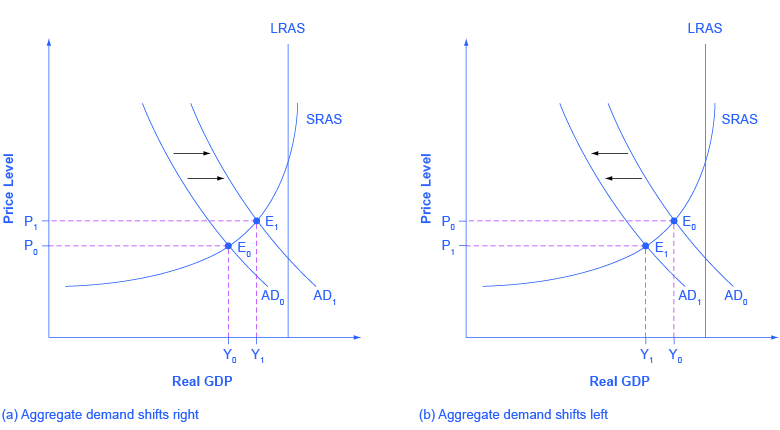
Because a rise in confidence is associated with higher consumption and investment demand, it will lead to an outward shift in the Advert curve, and a motility of the equilibrium, from Eastward0 to Easti, to a higher quantity of output and a higher price level, equally shown in Figure 1 (a).
Consumer and business organization confidence ofttimes reverberate macroeconomic realities; for example, confidence is usually high when the economy is growing briskly and depression during a recession. However, economical conviction can sometimes rise or fall for reasons that do not take a shut connexion to the immediate economy, like a risk of war, ballot results, foreign policy events, or a pessimistic prediction nearly the future by a prominent public figure. U.S. presidents, for example, must be careful in their public pronouncements near the economy. If they offer economic cynicism, they gamble provoking a decline in confidence that reduces consumption and investment and shifts AD to the left, and in a self-fulfilling prophecy, contributes to causing the recession that the president warned against in the first place. A shift of Advert to the left, and the corresponding movement of the equilibrium, from E0 to Due east1, to a lower quantity of output and a lower toll level, is shown in Effigy ane (b).
How Authorities Macroeconomic Policy Choices Can Shift Advertizement
Government spending is one component of AD. Thus, higher government spending will cause AD to shift to the correct, equally in Figure 1 (a), while lower regime spending will cause AD to shift to the left, as in Figure ane (b). For case, in the United States, government spending declined by 3.ii% of Gdp during the 1990s, from 21% of GDP in 1991, and to 17.8% of GDP in 1998. Nevertheless, from 2005 to 2009, the height of the Great Recession, government spending increased from 19% of GDP to 21.4% of Gdp. If changes of a few percentage points of Gdp seem small to you, remember that since GDP was nearly $14.4 trillion in 2009, a seemingly small change of 2% of GDP is equal to close to $300 billion.
Revenue enhancement policy can affect consumption and investment spending, likewise. Tax cuts for individuals will tend to increase consumption demand, while taxation increases will tend to diminish it. Tax policy can likewise pump up investment demand by offer lower revenue enhancement rates for corporations or tax reductions that do good specific kinds of investment. Shifting C or I volition shift the Advertizement curve as a whole.
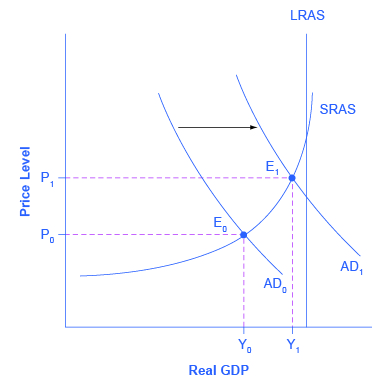
During a recession, when unemployment is high and many businesses are suffering depression profits or even losses, the U.S. Congress oftentimes passes tax cuts. During the recession of 2001, for instance, a tax cut was enacted into law. At such times, the political rhetoric often focuses on how people going through hard times need relief from taxes. The amass supply and aggregate demand framework, even so, offers a complementary rationale, every bit illustrated in Figure ii. The original equilibrium during a recession is at point E0, relatively far from the total employment level of output. The revenue enhancement cut, by increasing consumption, shifts the Advertisement curve to the right. At the new equilibrium (E1), real Gdp rises and unemployment falls and, because in this diagram the economy has non yet reached its potential or full employment level of GDP, whatever rising in the price level remains muted. Read the following Clear It Upward feature to consider the question of whether economists favor tax cuts or oppose them.
Do economists favor tax cuts or oppose them?
One of the about fundamental divisions in American politics over the last few decades has been between those who believe that the government should cut taxes substantially and those who disagree. Ronald Reagan rode into the presidency in 1980 partly considering of his hope, soon carried out, to enact a substantial tax cut. George Bush lost his bid for reelection against Bill Clinton in 1992 partly because he had broken his 1988 promise: "Read my lips! No new taxes!" In the 2000 presidential ballot, both George West. Bush and Al Gore advocated substantial tax cuts and Bush succeeded in pushing a parcel of revenue enhancement cuts through Congress early in 2001. Disputes over tax cuts oft ignite at the state and local level as well.
What side are economists on? Do they support broad revenue enhancement cuts or oppose them? The reply, unsatisfying to zealots on both sides, is that it depends. One issue is whether the tax cuts are accompanied past as large government spending cuts. Economists differ, as does any broad cross-section of the public, on how large government spending should be and what programs might be cut dorsum. A second effect, more relevant to the give-and-take in this chapter, concerns how shut the economy is to the total employment level of output. In a recession, when the intersection of the Ad and AS curves is far beneath the total employment level, tax cuts can make sense as a way of shifting Advertizement to the right. However, when the economic system is already doing extremely well, revenue enhancement cuts may shift Advertizement and so far to the right as to generate inflationary pressures, with little gain to GDP.
With the AD/Equally framework in mind, many economists might readily believe that the Reagan tax cuts of 1981, which took effect merely after 2 serious recessions, were beneficial economic policy. Similarly, the Bush-league taxation cuts of 2001 and the Obama tax cuts of 2009 were enacted during recessions. However, some of the same economists who favor taxation cuts in time of recession would exist much more dubious about identical revenue enhancement cuts at a fourth dimension the economy is performing well and cyclical unemployment is depression.
The use of government spending and tax cuts tin can be a useful tool to affect aggregate need and it will exist discussed in greater item in the Government Budgets and Financial Policy chapter and The Impacts of Government Borrowing. Other policy tools can shift the aggregate need curve as well. For example, as discussed in the Monetary Policy and Banking concern Regulation chapter, the Federal Reserve can affect interest rates and the availability of credit. College interest rates tend to discourage borrowing and thus reduce both household spending on big-ticket items like houses and cars and investment spending by business. Conversely, lower interest rates will stimulate consumption and investment demand. Interest rates tin besides affect exchange rates, which in turn will have furnishings on the export and import components of aggregate demand.
Spelling out the details of these alternative policies and how they bear upon the components of aggregate demand can wait for The Keynesian Perspective chapter. Here, the key lesson is that a shift of the amass demand curve to the right leads to a greater real GDP and to up pressure level on the price level. Conversely, a shift of aggregate demand to the left leads to a lower real Gross domestic product and a lower toll level. Whether these changes in output and price level are relatively large or relatively modest, and how the change in equilibrium relates to potential Gdp, depends on whether the shift in the Advertizing curve is happening in the relatively apartment or relatively steep portion of the AS curve.
Cardinal Concepts and Summary
The AD curve volition shift out as the components of aggregate demand—C, I, G, and 10–K—rise. It will shift back to the left as these components fall. These factors can change because of different personal choices, similar those resulting from consumer or business conviction, or from policy choices similar changes in authorities spending and taxes. If the Advertising curve shifts to the right, and so the equilibrium quantity of output and the price level will rise. If the Advertizement curve shifts to the left, then the equilibrium quantity of output and the price level will fall. Whether equilibrium output changes relatively more than than the price level or whether the price level changes relatively more than output is adamant past where the AD curve intersects with the AS bend.
The Advertisement/As diagram superficially resembles the microeconomic supply and demand diagram on the surface, just in reality, what is on the horizontal and vertical axes and the underlying economic reasons for the shapes of the curves are very dissimilar. Long-term economic growth is illustrated in the Advert/Every bit framework by a gradual shift of the aggregate supply curve to the correct. A recession is illustrated when the intersection of AD and As is substantially beneath potential Gross domestic product, while an expanding economy is illustrated when the intersection of Equally and Advertizement is near potential GDP.
Self-Check Questions
- How would a dramatic increase in the value of the stock marketplace shift the AD bend? What outcome would the shift have on the equilibrium level of Gdp and the cost level?
- Suppose Mexico, i of our largest trading partners and purchaser of a large quantity of our exports, goes into a recession. Utilise the AD/AS model to make up one's mind the probable impact on our equilibrium Gdp and toll level.
- A policymaker claims that tax cuts led the economic system out of a recession. Can we use the Ad/As diagram to testify this?
- Many financial analysts and economists eagerly await the printing releases for the reports on the home price index and consumer confidence index. What would be the effects of a negative report on both of these? What about a positive report?
Review Questions
- Name some factors that could crusade AD to shift, and say whether they would shift Advert to the right or to the left.
- Would a shift of AD to the right tend to make the equilibrium quantity and price level higher or lower? What about a shift of AD to the left?
Critical Thinking Questions
- If households determine to save a larger portion of their income, what effect would this have on the output, employment, and price level in the short run? What about the long run?
- If firms go more optimistic most the future of the economy and, at the same time, innovation in 3-D printing makes most workers more productive, what is the combined effect on output, employment, and the cost-level?
- If Congress cuts taxes at the aforementioned fourth dimension that businesses become more pessimistic nearly the economy, what is the combined effect on output, the price level, and employment using the AD/As diagram?
Solutions
Answers to Self-Bank check Questions
- An increase in the value of the stock market would make individuals feel wealthier and thus more confident near their economic state of affairs. This would likely cause an increment in consumer confidence leading to an increase in consumer spending, shifting the AD curve to the correct. The upshot would exist an increase in the equilibrium level of Gdp and an increment in the toll level.
- Since imports depend on GDP, if Mexico goes into recession, its Gdp declines and and then do its imports. This decline in our exports tin can be shown equally a leftward shift in Advertisement, leading to a decrease in our GDP and price level.
- Tax cuts increase consumer and investment spending, depending on where the tax cuts are targeted. This would shift AD to the correct, so if the revenue enhancement cuts occurred when the economy was in recession (and Gdp was less than potential), the tax cuts would increase GDP and "lead the economy out of recession."
- A negative report on habitation prices would brand consumers feel similar the value of their homes, which for most Americans is a major portion of their wealth, has declined. A negative report on consumer confidence would make consumers feel pessimistic most the future. Both of these would likely reduce consumer spending, shifting Advertising to the left, reducing GDP and the cost level. A positive report on the dwelling house toll index or consumer confidence would exercise the opposite.
Source: https://opentextbc.ca/principlesofeconomics/chapter/24-4-shifts-in-aggregate-demand/
0 Response to "what, if anything, did policymakers do in response to the recession of 2001?"
Post a Comment