what are some questions to ask a person who has been in a abusive relationship
- Lifestyle
- Life & relationships
- Domestic violence
Stance
The question too many of u.s. still enquire about abusive relationships
By Tarang Chawla
I won't ever forget the concluding conversation I had with my sis Niki.
Nosotros had plans for Sun lunch and I texted her on the Thursday night leading up to the weekend, "Are you going to be there?"
"OMG why wouldn't I exist? Can't wait!!" she wrote dorsum.
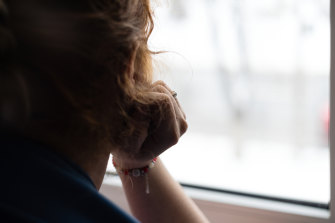
Separation and the menstruation immediately following it, is one of the unmarried most dangerous times for whatever woman who has been in an abusive relationship. Credit:iStock
But Niki never made information technology to luncheon. And she hasn't been to a family tiffin always since.
The post-obit morning, two uniformed Victoria Law officers knocked on our forepart door. They came to tell usa that Niki was murdered by her partner in the middle of the dark on Friday, January nine, 2015.
Whenever I think nearly Niki and how she took her final, painful breaths, I am always jolted back to reality with the realisation that on average, one woman a week is killed by a current or erstwhile male partner in Australia.
The backwash of Niki's murder brought with it the grief of losing someone you love dearly, the cost of the courtroom process and the experience of having media cameras parked outside your home, simply it as well highlighted the lack of understanding around why people – women peculiarly – are not able to get out tearing or abusive relationships.
Many people immediately assumed that Niki'due south murder was her own error and they weren't afraid to say information technology. My family received many victim blaming messages from seemingly well-educated people. I distinctly call up i person telling me "What did she think would happen? She got what she deserves," while others, including some journalists, pointedly asked questions like, "Why didn't she just get out?" every bit if we could replenish them with an appropriate response.
Too many of united states still enquire this same question. When a woman is murdered by a human being who once claimed to love her, nosotros're not asking the right questions. If just we knew and appreciated the painful truth and reality of domestic violence: Leaving an calumniating relationship is frankly never as straightforward as we would like it to be.
While recording There's No Identify Like Home, Future Women'southward new podcast nearly domestic abuse and family violence, it became clearer to me that for almost every woman who has left an abusive relationship and survived to be in a position to share her feel, the abuse didn't end one time the relationship did.
In fact, separation and the menstruum immediately post-obit information technology, is i of the single near dangerous times for any adult female who has been in an abusive relationship. What makes information technology harder to understand for people is that post-separation corruption takes many forms. In its worst form – and something my family knows all likewise well – information technology results in murder. But that isn't always the case.
What society often fails to grasp is the fact that the precursors to homicide, such as non-physical forms of abuse and coercive control, wear down victim-survivors, with many victims fifty-fifty blaming themselves for their own abuse.
In some relationships where there was no concrete violence present during the relationship, perpetrators became tearing following the break-up. In other instances, perpetrators stalked and harassed victim-survivors or even relied on legal channels such as the courts to draw out proceedings, emotionally and financially wearing downward their victims to retain a sense of ability and control, even later the human relationship is over.
For some victim-survivors, including Deborah, who features in the final episode of the serial, the inability to access money and resources kept her and her children trapped with their abuser even after she knew she needed to leave. For others, such as May in episode iv where we reframe the upshot by asking, "If she leaves, where will she become?", the risk of homelessness meant that an dangerous abode remained ane of the just options bachelor to her.
Yet, financial factors such as a risk of homelessness and access to financial resources are simply ii of the reasons women are trapped with their abuser. And this is the case despite the fact that family violence is one of the leading causes of homelessness for Australian women.
In fact, research cited by Relationships Australia confirms that a woman may effort to leave a relationship up to seven times before she is successful. Women in abusive relationships are, quite literally, doing everything they conceivably tin to "exist safe".
What society ofttimes fails to grasp is the fact that the precursors to homicide, such as not-physical forms of abuse and coercive control, wear down victim-survivors, with many victims fifty-fifty blaming themselves for their ain abuse, specially in relationships where the abuser "gaslights" their victim by making them question their own sense of reality.
Victim-survivors are often seen as complicit in their ain corruption, the exact same way Niki was – fifty-fifty later she'd had her life stolen from her. This is in part because of the social context in which romantic relationships exist and that domestic abuse and family violence are often seen as topics non to exist openly discussed.
When Nikita was murdered seven years ago, the national conversation around violence confronting women was still firmly placing the onus on women to ensure they are safe, rather than enervating that men who are abusive take responsibility and accountability for their actions.
While there is a slow, but long overdue, shift in this regard thank you to the work of many victim-survivors and sector experts, what we all the same see is a lack of understanding most how challenging it can be for women to leave and that economic factors are but the beginning.
Loading
My promise remains that while it's e'er going to be besides tardily for my babe sister Niki to go out her abuser safely, that listeners of There's No Place Like Habitation hear immediate from victim-survivors, and together, we all play our part in shaping an Australia without family violence.
Tarang Chawla is the host of In that location's No Place Like Domicile, a new podcast past Future Women x CommBank about domestic abuse and family violence. Subscribe to heed here.
Make the near of your wellness, relationships, fitness and diet with our Live Well newsletter. Go information technology in your inbox every Mon.
Source: https://www.smh.com.au/lifestyle/life-and-relationships/the-question-too-many-of-us-still-ask-about-abusive-relationships-20220301-p5a0j0.html
0 Response to "what are some questions to ask a person who has been in a abusive relationship"
Post a Comment